


 065: Dig Eastern Mongolia: explore the world of ancient nomads
Course Format
Directed at
This programme accepts participants with or without previous experience. You will learn survey and excavation techniques and methodology from the very beginning. No previous knowledge of archaeology or of computer software is required. The minimum age is 18.
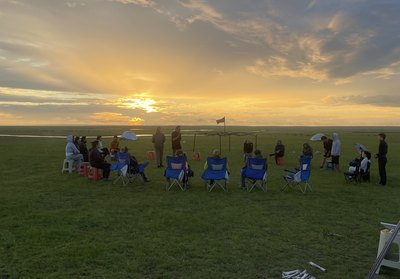
The course takes place in an expedition camp on the steppe, with the basic comforts described in Dates & Tuition. It suits students who enjoy outdoor life and working in a small team: each session is limited to 6 participants.
Field School life & language
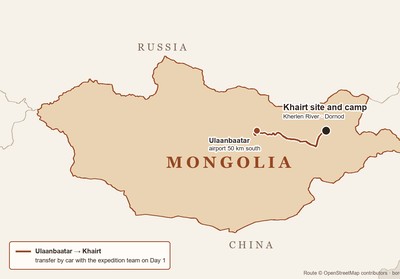
The session starts in Ulaanbaatar. On Day 1 the expedition team takes the group of students to the camp base, where the course is introduced and students settle in to start survey and excavation the next day.
The camp, with sleeping gers, a kitchen ger and a field laboratory, stands next to the Khairt site on the southern bank of the Kherlen River. After breakfast, fieldwork runs from 8 a.m. to 12 noon. Lunch is served at the camp, and from 1 to 5 p.m. you write up your field notes, attend lectures and work on the finds and the survey data. Dinner is at about 6 p.m.
Students work in two teams: one surveys while the other excavates, and they swap after the first week, so everyone takes part in both. Each session includes 11 days of fieldwork, an excursion to Khulunbuir to see local nomadic life, and rest days. The course is taught in English, and the Mongolian students and staff all speak English.
Mongolia, Ulaanbaatar and the steppe
Mongolia is the least densely populated country in the world: a land of open steppe, mountains and desert where many families still live as herders and move their gers with the seasons. Ulaanbaatar, the capital, is home to almost half of the country's people. It is a lively, modern city with the National Museum of Mongolia, the Gandan Monastery and the Chinggis Khaan Museum, and plenty of cafés, restaurants and good hostels, so it is worth spending a day or two there before or after the course. The road east crosses Khentii province, the homeland of Chinggis Khaan, and reaches the steppe of Dornod, where the Kherlen River winds through open grassland and the Khairt site lies.
Climate and conditions. In June and July the days are warm (20-25 °C, sometimes hotter) and the nights cool (15-20 °C). These are pleasant temperatures for fieldwork, much milder than the summer heat of Mediterranean field schools. Wind and short summer storms are common, so bring warm layers and a rain jacket. Life at the camp is simple: you sleep in a heated ger, eat meals cooked by the expedition cook and share the day with Mongolian archaeology students and staff, all of whom speak English.
Money. International cards (Visa, Mastercard) are accepted in shops, restaurants and hostels in Ulaanbaatar and in the shops of Khulunbuir, but carry some cash in Mongolian tugrik for small purchases, showers in town and travel around the country: about USD 30 per day in the field and about USD 50 per day in Ulaanbaatar. You can get tugrik on arrival from the cash machines and exchange counters in the airport arrivals hall (change only a small amount there, as the rates are better in the city) and in banks and cash machines in Ulaanbaatar.
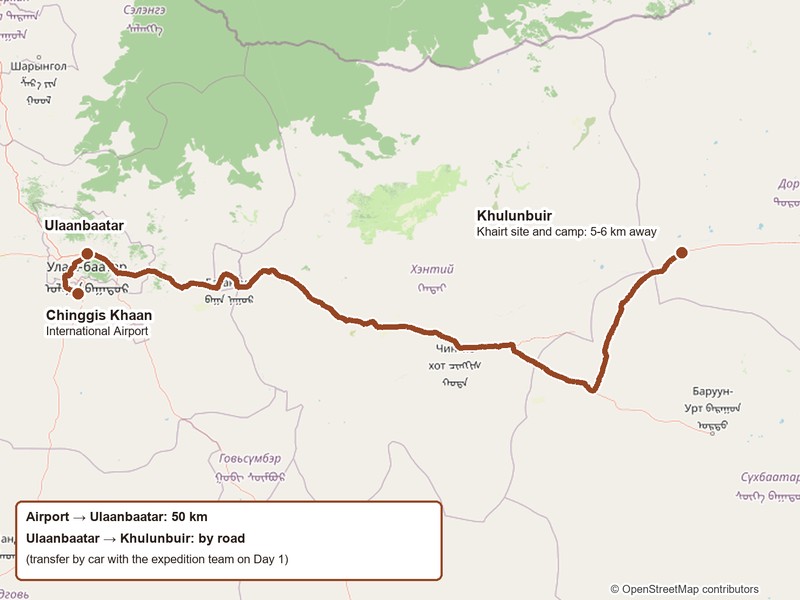
Route from Chinggis Khaan International Airport to Ulaanbaatar and Khulunbuir. © OpenStreetMap contributors
How to get there and what to bring (PDF)
Assessment and certificate
Students keep a daily field journal, complete the course recording sheets and give a short final presentation; together with daily participation these make up the final grade (A to F). At the end of the course students receive a Certificate of Completion stating the course, dates, 85 instructional hours and final grade. On request, the Course Director issues a Student Evaluation Report for the student's university, and students with outstanding performance may receive a letter of recommendation. See the syllabus (PDF) and the Academic Credit page.